
By Kyle Ellington
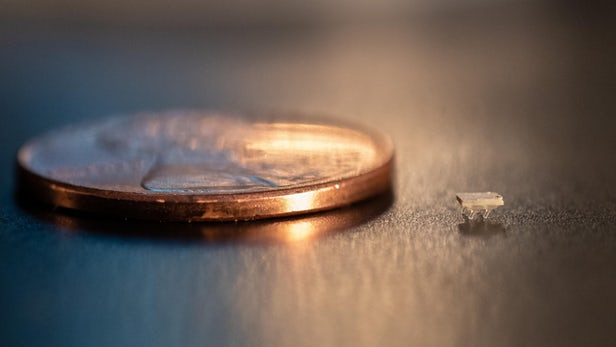
Micro robots that are able to move inside the human body, it sounds like something that has come straight out of a sci-fi movie but it seems that the idea is very possible and could one day happen that’s why Georgia Tech’s new “micro-bristle-bots” are.
The robots are propelled by using vibrations instead of battery, the robots are 3D printed out of polymer resin, via a process known as two-photon polymerization lithography and each one has either four or six springy “legs”.
When vibrations are delivered to the robot via either a shake table, an external ultrasound/sonar source, or a tiny acoustic speaker, those vibrations cause the angled legs to move up and down, propelling the robot forward. The onboard actuator can also produce the vibrations when subjected to an electrical current, although that current presently must come from a hard-wired source. Later in the future it may be possible to wirelessly activate the actuator using electrical fields.
The amplitude of the vibrations determines the speed at which the robots move. The bots can be designed to respond to different vibrational frequencies. Therefore, by linking together two differently designed robots that respond to different frequencies, it should be possible to steer the two by varying the frequency and amplitude of the vibrations.
“We are working to make the technology robust, and we have a lot of potential applications in mind,” assistant professor Azadeh Ansari said in a release
The possibilities that this invention presents is endless at what it can do for medical science. You could be able to inject tiny robots with little cameras into the blood stream of a patient to determine if there is anything wrong with them medically that can’t be shown on an x-ray.
Hundreds of the devices have already been created, and the researchers are now looking at ways of scaling up the manufacturing process, so that thousands could be made at once.
The idea that you can steer them with vibrations is even better because they won’t have to worry about what would happen if one were to die.
There could also be the possibility that if there is enough progress that is done with the robots that they could even treat injuries within the human body that may to deemed too difficult by the medical staff.
 Site Title